Are you ready to garden yet? I am. I have a treat for you today if you love heirloom gardens and gardening. I am reviewing Heritage Gardens and Heirloom Seeds: Melded Cultures with a Pennsylvania German Accent.
Never before has there been a book to include a complete background on heritage or traditional gardening and heirloom seeds. At over 270 pages the book is loaded with pictures of plants and gardens of America from their very beginnings. The book is divided into five sections. In this order:
I. Which Came First, the Garden or the Seed?
II. The Heritage Garden
III. Visiting Gardens, Garden Sites, and Heritage Landscapes
IV. Heirloom Seeds
V. The Galleries (pictures)
Costumed interpreters cultivate and harvest crops. (pg.79)
In the first section the book begins with the discussion of the locally sourced foodstuff movement that has grown in America and the importance that has generated in the restaurant industry and communities alike. The importance of heirloom varieties is that they were developed before modern agriculture became chemically drenched and genetically modified. This makes the heirloom seeds significantly valuable because they are being preserved from extinction and many of them are without compare in modern agriculture. The gastronomic virtues of flavor and taste not mention the preservation of the historically correct seed is of paramount importance.
(pg. 81)
The second section of the book is "The Heritage Garden," of which the authors explore the history of the gardening tradition in North America. The history begins with the Native American contribution to our harvest table, the Spanish influences, Anglo-Dutch traditions, French, and the Pennsylvania German Garden. The most significant being the Pennsylvania German because these heritage garden forms lasted the longest among the Pennsylvania Germans. The authors truly take you back to the origin of this gardening from sharing the emigrants opening their traveling chests and pulling out seeds and cuttings that originated from kitchen and medicinal gardens of Benedictine cloisters in Switzerland and Germany. (pg.45) They share the structure of these gardens including the dimensions, composition (including the four square garden), how they gardens were uniquely watered, and the tools with which they kept them. They explain what was grown in these gardens and how, the folklore about planting, and when to plant. Included are real historical letters with vivid descriptions of the gardens. (pg. 70)
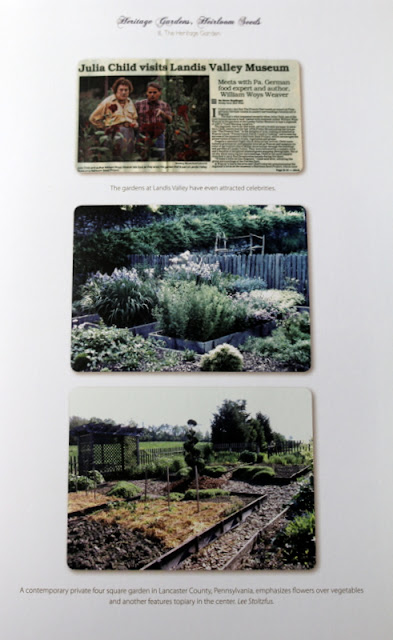
(pg.83)
This history of gardening also can't be mentioned without including religion and beliefs pertaining to the garden by the gardeners. The Quaker beliefs were that the earth was a gift from God to man. Man had the responsibility of cultivating the earth for his own benefit and celebration of God's goodness. (pg. 71) None of this went unnoticed by celebrities that were ahead of their time. Pictured above (pg. 83) is Julia Child visiting the Landis Valley Museum. This museum has been a pioneer on the revival of the traditional Pennsylvania German garden and it is home to the Heirloom Seed Project. (pg. 73)
(pg. 95)
Here is an example of runway or ribbon gardening by the Amish and Mennonite in Lancaster county Pennsylvania. The one on the top right could have been my Great-Grandfather's garden from the Kentucky tobacco farm I grew up around as a child.
from: gallery of heirloom vegetable varieties (pg. 243)
The next chapter of the book describes the genesis of the seed industry and how it shifted from growing fields to the laboratory. Much is discussed about the history of the seed packets in America and the seed houses that produced them and how each year fewer and fewer varieties of these seeds are on the market. The Seed Savers Exchange founding and work is discussed and how that morphed into the Landis Valley Farm's Heirloom Seed Project.
Also included is complete instruction on how to harvest seeds and save different varieties. Pictured here is a year's harvest of seeds stored tightly in glass jars and covered by a drape to protect them from light. (pg. 208)
from: the galleries of heirloom vegetables and flowers (pg.261)
Then the book describes the Heirloom Seed Project's many popular varieties of seeds and plants not excluding some of my favorite herbs and flowers!
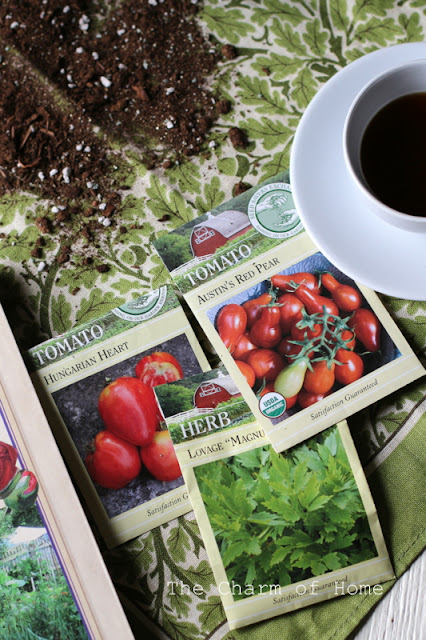
It just so happens, I am a Seed Savers Exchange customer and I have three plants here that I have started from seed this very year! I thought I would share them here with my book review.

This is one of these two varieties of tomato I have shown here. It is either the Hungarian Heart tomato or the Austin's Red Pear. I will figure it out when it fruits. I first got interested in the heirloom vegetables while reading Eating on the Wild Side: The Missing Link to Optimum Health by Jo Robinson. Having a background as a RN, I have always been studying the proper way to eat for health and it turns out that there is a dramatic difference in the plant varieties we cultivated in the past from the ones on our grocery store shelves today and that difference is the nutrition is bred out of our modern produce. In this book "Eating on the Wild Side," Jo Robinson mentions eating specific varieties of produce that have the most nutrition and that is how I came to order these seeds for my tomatoes. They have the most nutrition packed into a tomato you can get! So, that began my adventure into heirloom gardening.
I highly recommend this book if you or a gardening friend have a love of heritage gardens or heirloom seeds and plants. It is a valuable resource and a wonderful testimony to why we need to preserve our heirloom seeds and plants. The diversity offered in nature is there for a reason and to hybridize it out of all food and plant life is a big mistake. The wisdom in the natural order of plant life is a valuable commodity worth studying and preserving. I also recommend the book as an excellent reference book on heritage gardens and heirloom seeds and plants. I really enjoyed this book and I will keep it for a reference for my heirloom gardening. I have really enjoyed reading the history of gardening in America and the historical letters about gardening in this book. The history and folklore surrounding the emigrants gardening has been woven into the fabric of our farming communities and it is wonderful to see it documented in this book.
Thank you to Elizabeth at Schiffer Publishing, Ltd. for providing me with a copy of this book for review. The review and opinions were entirely my own.
Sherry


